Individualized learning came from a need to create a more educated and efficient work force. Companies looked to behaviorism theories of learning that focused on stimulus and responses theories to explain learning. The early "teaching machines" were designed to educate workers so that they could work faster and efficiently.
Behaviorist Family Tree
Behaviorism, focused on individualized learning perspectives and procedures. Teaching machines were developed in mid 1920’s for basic question and answer type material. Upon giving the correct answer the learner was immediately rewarded. In the 1950’s, Skinner updated the teaching machine to “programmed instruction”. Based on Skinner’s theory of with the intent to speed up conventional learning methods. His plan included self-teaching with a specialized textbook and a teaching machine presenting material in a logical and structured sequence. Students could advance at their own pace, checking their answers along the way. The behaviorist model presented material in increments so that students to achieve total accuracy. Access to Skinner's works is provided by the B.F. Skinner Foundation
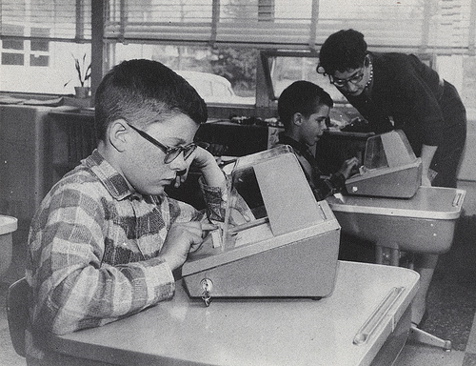
photo from http://www.zemos98.org/eduex/spip.php?article159
Behaviorism Principles:
1. Behavior that is positively reinforced will reoccur; intermittent reinforcement is particularly effective
2. Information should be presented in small amounts so that responses can be reinforced and shaped.
3. Reinforcements will generalize across similar stimuli ("stimulus generalization") producing secondary conditioning
Practical Example:
1st: The exercise should be in the form of question (stimulus) and answer (response) which exposes the student to the subject in gradual steps.
2nd: Require the learner to make a response for every frame and receive immediate feedback.
3rd: Arrange the difficulty of the questions so the response is always correct and the student receives positive reinforcement.
4th: Always ensure that good performance in the lesson is paired with secondary reinforcers such as verbal praise, prizes and good grades.

clip from www.drawception.com
The simplest way of giving positive reinforcement to create behavior modification is providing compliments, approval, encouragement; a ratio of five compliments for every one complaint is generally seen as being the most effective in altering behavior in a desired manner.
Fifty years later, these basic ideas have developed. Courses can now be offered in a traditional face to face traditional classroom format, all online, or a blended version with both online and face to face class time. Education and technology have created students who are considered digital natives. Meaning today’s students are born and raised in a digital environment and technology in the classroom is natural for today’s 21st century student.
Using technology in the classroom allows teachers to create individualized and differentiated lessons. Current technology broadens individualized instruction and promotes personalized learning. Students are encouraged to use technology in creative ways. Some students to individually progress from using low ordered skills gained from drill and practice to higher level thinking through applying concepts.
References:
Fischman, J. 2011, May 8 The Rise of Teaching Machines Retrieved from http://chronicle.com/article/The-Rise-of-Teaching-Machines/127389/
McLeod, S. A. (2007). Skinner - Operant Conditioning. Retrieved from http://www.simplypsychology.org/operant-conditioning.html
Harasim, Linda (2012-03-22). Learning Theory and Online Technologies. Taylor and Francis. Kindle Edition.
Image: Teaching Machine http://www.zemos98.org/eduex/spip.php?article159

This comment has been removed by the author.
ReplyDelete