You are to create a new blog posting in which you profile an assigned instructional
model. These models are assigned randomly. Your model will be assigned
by the end of the first week of class. This profile must include the
family tree, so to speak, of your instructional model. In other words,
what overarching theoretical school does your instructional model fall
under (objectivism/behaviorism. cognitivism/pragmatism or
constructivism/interpretivism) and, in brief, what are that school's
general characteristics. You should describe the basic principles of
your assigned instructional model and should include at least one
relevant link. You should include a practical example of the
instructional model at work. You should devote more attention to the
model than its school.
Rich Environments for Active Learning - REALs
Rich Environments for Active Learning is an instructional model based on constructivist ideas. Rich Environments for Active Learning is highly student involved teaching style. This is a student centered learning instructional model instead of a teacher led instructional model. This learning model can be implemented by using cooperative learning, generative learning, student centered learning, and problem based learning. (Schott)
General Characteristics
The general characteristics of REALs are that in which the students are highly involved in their learning of the information that the teacher is teaching in the lesson. This can be best described as the students being active learners. Some of the ways that they can be active learners by doing group work, real life connections for understanding,
Theoretical Family Tree
Rich Environments for Active Learning call under the constructivism/interpretivism family. In this teaching style students are actively learning. Student learning can be categorized with the following five themes (Bostock, 1998):
1. Student responsibility and initiative
2. Generative learning strategies
3. Authentic learning contexts
4. Authentic assessment
5. Cooperative support
Rich learning environments go beyond the standard learning environment of textbooks, prepared materials and teacher led instruction. (Roblyer, Edwards & Havriluk, 1996). The five basic resources according to Perkins for a "rich environment" are:
Information Banks, Symbols Pads, Construction Kits, Phenomenaria, Task Managers.
The Information Banks allow access to required information and are comprised of encyclopedias and books. Symbol Pads support a learners short term memory and are comprised of notebooks and laptops.Construction Kits aid in manipulation and building. Common construction kits are, Lego's, Kinects, Lincoln Logs, Tinker toys and Magnetix. Phenomenaria allows for exploration for example in a terrarium, computer simulation, and virtual tours/field trips. Task Managers give help and feedback when tasks are completed. This can be given by a teacher or online tutor.
Practical Example of REALs at Work
One of the many ways that I can use REALs in my classroom is by having my students building a replica of an important place in history. This assignment uses cooperative learning, generative learning as well as problem based learning. The cooperative learning is if they choose to work with a partner, then they will have to clearly communicate their thinking and how they plan on replicating their historical point of interest with their partner. The generative learning element is when the students take what they have learned through their research and make their physical model out of that information. The problem based learning element comes when the students have to figure out how they will get their model to look accurate. They may have to attempt the building a few times before they get it to look appropriate. Some of these places could be the Pyramids of Giza, White House, Taj Mahal, A Mission etc... They can easily build these replicas out of Lego's. The students will have to use technology in the classroom in order to research the important place they will be building with the Lego's. This assignment is very hands on in addition to getting their creative juices flowing. I feel that this will allow my students to get creative and take the information that they have learned and transfer that into a physical object that is accurate. My students can also go on a virtual field trip of theses places by using Google Earth on a computer (laptop or desktop) or on a tablet. By using this method they do not have to physically go to that place they can got virtually. They can also explore the area by zooming in to the street level view. Also they are able to zoom out and get a perspective as to where the historical place of interest is geographically compared to where they are living. In addition to where other important paces are in the country and world. This entire exercise will allow my students to learn in an alternative way, instead of just reading about the places in their history book they will be exploring the places with technology, delving as deep into the information as they wish to go in order to get the out come to be what they want it to be. This lesson is a prime example of student centered learning. The students have a time frame to work in, how they choose to use their time is up to them as long as they complete the assignment. I will be at the students disposal to help them in any way that they need.
Relevant Link
http://www.researchinlearningtechnology.net/index.php/rlt/article/viewFile/9606/11214
This link is to a paper written by R. Scott Grabinger and Joanna C. Dunlap. The pap er is a bit on the lengthy side but itis full of useful information regarding Rich Environments for Active Learning.
With the birth of the technological age everything is literally available at your fingertips. It is just a matter of what you do with the information that you find and how you use it in your academic and/or daily life.
Saturday, May 31, 2014

Sunday, May 18, 2014
Individualized Learning - T Paisley
Necessity is the mother of invention
Individualized learning came from a need to create a more educated and efficient work force. Companies looked to behaviorism theories of learning that focused on stimulus and responses theories to explain learning. The early "teaching machines" were designed to educate workers so that they could work faster and efficiently.
Behaviorist Family Tree
Behaviorism, focused on individualized learning perspectives and procedures. Teaching machines were developed in mid 1920’s for basic question and answer type material. Upon giving the correct answer the learner was immediately rewarded. In the 1950’s, Skinner updated the teaching machine to “programmed instruction”. Based on Skinner’s theory of with the intent to speed up conventional learning methods. His plan included self-teaching with a specialized textbook and a teaching machine presenting material in a logical and structured sequence. Students could advance at their own pace, checking their answers along the way. The behaviorist model presented material in increments so that students to achieve total accuracy. Access to Skinner's works is provided by the B.F. Skinner Foundation

Fifty years later, these basic ideas have developed. Courses can now be offered in a traditional face to face traditional classroom format, all online, or a blended version with both online and face to face class time. Education and technology have created students who are considered digital natives. Meaning today’s students are born and raised in a digital environment and technology in the classroom is natural for today’s 21st century student.
Using technology in the classroom allows teachers to create individualized and differentiated lessons. Current technology broadens individualized instruction and promotes personalized learning. Students are encouraged to use technology in creative ways. Some students to individually progress from using low ordered skills gained from drill and practice to higher level thinking through applying concepts.
References:
Fischman, J. 2011, May 8 The Rise of Teaching Machines Retrieved from http://chronicle.com/article/The-Rise-of-Teaching-Machines/127389/
McLeod, S. A. (2007). Skinner - Operant Conditioning. Retrieved from http://www.simplypsychology.org/operant-conditioning.html
Harasim, Linda (2012-03-22). Learning Theory and Online Technologies. Taylor and Francis. Kindle Edition.
Image: Teaching Machine http://www.zemos98.org/eduex/spip.php?article159
Individualized learning came from a need to create a more educated and efficient work force. Companies looked to behaviorism theories of learning that focused on stimulus and responses theories to explain learning. The early "teaching machines" were designed to educate workers so that they could work faster and efficiently.
Behaviorist Family Tree
Behaviorism, focused on individualized learning perspectives and procedures. Teaching machines were developed in mid 1920’s for basic question and answer type material. Upon giving the correct answer the learner was immediately rewarded. In the 1950’s, Skinner updated the teaching machine to “programmed instruction”. Based on Skinner’s theory of with the intent to speed up conventional learning methods. His plan included self-teaching with a specialized textbook and a teaching machine presenting material in a logical and structured sequence. Students could advance at their own pace, checking their answers along the way. The behaviorist model presented material in increments so that students to achieve total accuracy. Access to Skinner's works is provided by the B.F. Skinner Foundation
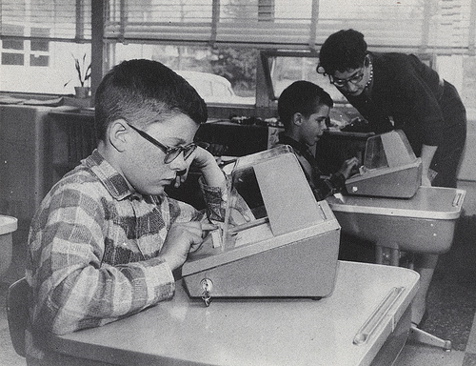
photo from http://www.zemos98.org/eduex/spip.php?article159
Behaviorism Principles:
1. Behavior that is positively reinforced will reoccur; intermittent reinforcement is particularly effective
2. Information should be presented in small amounts so that responses can be reinforced and shaped.
3. Reinforcements will generalize across similar stimuli ("stimulus generalization") producing secondary conditioning
Practical Example:
1st: The exercise should be in the form of question (stimulus) and answer (response) which exposes the student to the subject in gradual steps.
2nd: Require the learner to make a response for every frame and receive immediate feedback.
3rd: Arrange the difficulty of the questions so the response is always correct and the student receives positive reinforcement.
4th: Always ensure that good performance in the lesson is paired with secondary reinforcers such as verbal praise, prizes and good grades.

clip from www.drawception.com
The simplest way of giving positive reinforcement to create behavior modification is providing compliments, approval, encouragement; a ratio of five compliments for every one complaint is generally seen as being the most effective in altering behavior in a desired manner.
Fifty years later, these basic ideas have developed. Courses can now be offered in a traditional face to face traditional classroom format, all online, or a blended version with both online and face to face class time. Education and technology have created students who are considered digital natives. Meaning today’s students are born and raised in a digital environment and technology in the classroom is natural for today’s 21st century student.
Using technology in the classroom allows teachers to create individualized and differentiated lessons. Current technology broadens individualized instruction and promotes personalized learning. Students are encouraged to use technology in creative ways. Some students to individually progress from using low ordered skills gained from drill and practice to higher level thinking through applying concepts.
References:
Fischman, J. 2011, May 8 The Rise of Teaching Machines Retrieved from http://chronicle.com/article/The-Rise-of-Teaching-Machines/127389/
McLeod, S. A. (2007). Skinner - Operant Conditioning. Retrieved from http://www.simplypsychology.org/operant-conditioning.html
Harasim, Linda (2012-03-22). Learning Theory and Online Technologies. Taylor and Francis. Kindle Edition.
Image: Teaching Machine http://www.zemos98.org/eduex/spip.php?article159
Case Based Learning presented by Yesenia Preciado
Case Based Learning presented by Yesenia Preciado
What is Case Based Learning?
Case Based learning is getting students to relate to real
world through discussions of specific examples. The focus for students includes
building knowledge and analyzing situations. This style of learning is mostly
used for business education, medicine. (Harasim, 2012). Students use case
study’s to learn a concept and do so by using dialogue and analytical skills.
Characteristics of Case Based Learning in the Classroom
Features that case based learning include: exploring real
world examples, students working together, discussing specific examples, and
discussing questions with more than one answer. The students also make
connections from the real world examples to their own personal lives. Students
can make connections to their own lives to help them formulate discussion. The
role of the teacher is to facilitate discussion among students.
Theoretical Family of Case Based Learning
Constructivism is where Case Based Learning derived from and
has its foundation for instructional model. “Constructivism refers both to a
learning theory (how people learn) and to an epistemology of learning (what is
the nature of knowledge)(Harasim, 2012,p. 60).” In other words, the theory is mostly
based on the process of learning. There are two major influential thinkers in this school of
thought. One being Jean Piaget and the other was Lev Semyonovich Vygotsky. Piaget focused his theory on cognitive
constructivism, which basically means how a “learner understands the world, in
terms of biological development stages”(Harasim, 2012,61). ”Vygotsky emphasized
social constructivism, which focused on how “meanings and understandings grow
out of social encounters (Harasim, 2012,61)”. Both of these enlightened
thinkers contributed to the Constructivist view in which the Case Based
Learning has its theoretical family ties.
Example of using Case Based Learning
An example of using a case study is when studying a famous
incident in history. For example learning about civil rights, students can read
a legal case studiy like Plessy v. Ferguson and other law cases that give
students an opportunity to analyze the situation, make their own inferences,
and relate to real life issues and how those cases made a difference in our civil
rights movement. Many case studies can be found on different subjects in whom
students are allowed to cerate dialogue and their analytical skills to
determine connections. The process of analyzing these case studies allows
people to learn in this manner. Teachers
standby and facilitate this discussion.
Helpful Links
References
Harasim, L. (2012). Learning theory and online technologies.
New York, New York: Routledge.
Authentic Learning - By Jason Pinsker
Authentic Learning - Profile by Jason Pinsker
If ever a student complained about how a certain lesson was never going to be needed in the real world, they weren't talking about Authentic Learning. Authentic Learning refers to a type of instruction that takes into account the applicability of a given topic outside the classroom, specifically the professional workplace. According to Tiffany Mara ("Authentic Learning," n.d.), "Authentic learning says that...we should learn what happens in the "real world", and become "cognitive apprentices" to the experts" (p. 1, para. 3).
General Characteristics:
Authentic Learning involves students taking on the role of a non-student in order to learn how to apply knowledge to real-word scenarios. "Authentic activities focus on active learning in real-world contexts, and typically involve production, rather than activities that are abstract and remote from practice" (Harasim, 2012, p.69). The goal of authentic learning is not to have students make-believe, but to develop the skills and cognitive processes for solving problems in an authentic environment.
The idea of Authentic Learning has been embraced by many educators and institutions. A brief video of a group of educators discusses their take on Authentic Learning: https://www.youtube.com/watch?v=UNP7hv0d0Rk
Technology and Authentic Learning:
There is a major connection between technology and authentic learning. Technology is used by both students and professionals, and act as authentic experience without involving travel. Technology such as the Internet, allows people to access and interact with elements around the world authentically, albeit remotely. Mara (n.d.) notes that, "computers are best utilized as supplements to good learning environments and provide tools that normally would not be available to students." (p. 4, para. 5). With the influx of technology in our daily lives, both students and professionals often have access to the same type of tools (word processing, the Internet, professional graphics software, etc.). The very use of these tools in a way consistent with a given professional industry, is a true authentic learning event.
Family Tree:
Authentic Learning falls within the Constructivism/Interpretivism school largely because it relates to the individuals' learning experiences. Where Behaviorism is concerned with stimulus and response in terms of learning, Cognitivism is concerned with. "what comes between stimulus and response, seeking to understand the processes of the mind..." (Harasim, 2012, p.47). Authentic Learning falls within the Constructivism/Intrepretivism school because it allows the learner to interact with the actual challenges that face individuals in the world. "Learning activities should be authentic and should center around the problematic or puzzlement as perceived by the learner" ("Instructional Design Knowledge Base," 2014).
Practical Examples:
The beauty of Authentic Learning is that it is utilized by teachers unknowingly. Every time an activity uses knowledge to solve a task based in reality, it is considered authentic. For example, a science experiment where a genuine hypothesis is acted upon, is authentic (as opposed to working out a hypothetical science experiment as an excise in a textbook, for example).
Example 1: Biology laboratory experiment. This high school lab experiment introduces students to the scientific method and has them participate in an experiment that is applicable to the real world. Students test glow sticks that are designed to be used as fishing lures. They test the sticks' performance in different water temperatures and have to carefully log their results. This activity is authentic because it involves testing an actual product just as scientists would prior to it being marketed. http://jfmueller.faculty.noctrl.edu/toolbox/examples/osterberg00/lightsticklab.htmPromotional videos for campus
Example 2: Promotional School Video. This assignment would be designed for a secondary video production class. It would involve students helping to create a promotional advertisement for their school. Students would select an aspect of school life and create a video based on it that features flattering imagery, interviews, and editing. This activity would be authentic because students would be producing a video in the same manner than a professional advertising agency might, and the finished products could ideally be used to promote the school's programs. An example of promotional school videos: https://www.youtube.com/watch?v=rMxHwPdCir0
References:
Mara, T. (n.d.). Authentic learning. Retrieved from: http://www-personal.umich.edu/~tmarra/authenticity/authen.html.
Harasim, L. (2012). Learning Theory and Online Technologies. New York: Routledge.
Collaborative for Teaching and Learning (2013, Sept. 6). What is Authentic Learning? [Video file]. Retrieved from https://www.youtube.com/watch?v=UNP7hv0d0Rk
Instructional Design Knowledge Base. (2002-2014). Goals of Instruction: Constructivism/Interpretivism. Retrieved from: http://cehdclass.gmu.edu/ndabbagh/Resources/IDKB/models_theories.htm#theories
Mueller, J. (2010). Light Stick Lab (Formal Lab Report). Retrieved from: http://jfmueller.faculty.noctrl.edu/toolbox/examples/osterberg00/lightsticklab.htm
Affixxius (2012, Jan. 11). Promotional Video Showreel - Affixxius Education [Video file]. Retrieved from https://www.youtube.com/watch?v=rMxHwPdCir0
Discovery Learning presented by Maria Peralta
What is Discovery
Learning?
Discovery Learning is
an active process of inquiry-based instruction that encourages learners to
build on prior knowledge through experience and to search for new information
and relationships based on their interests.
History of Discovery
Learning
The principles of
discovery learning in a book was about how people construct knowledge based on
prior experiences was first outlined in 1967 by the Psychologist and cognitive
learning theorist, Jerome Burner.
Similar constructivist learning theories were developed by
John Dewey, Jean Piaget, and Lev Vygotsky, all of whom suggested that discovery
learning encourages students to become active participants in the learning
process by exploring concepts and answering questions through experience.
Discovery Learning in Practice
The educational goals of discovery learning are to promote a
deep understanding, developing meta-cognitive skills, and encouraging a high
level of student engagement.
Types of Discovery
Learning
•
Experiments
•
Exploration
•
Stimulation-based Learning
Support and Criticism
Pro-discovery learning
theory explain that this theory will actively engage students in the learning
process, motivate students to practice, encourage autonomy and independence,
promote the development of creativity and problem-solving skills, and provide
an individualized learning experience.
On the contrary,
anti-discovery learning theory cautioned that this theory may be overwhelming
for learners who need more structure, may allow for possible misunderstanding,
and may prevent teachers from gauging whether students are having difficulties.
Discovery Learning Family Tree

Retrieved from:http://etec.ctlt.ubc.ca/510wiki/images/thumb/f/f9/Cognitivism2.jpg/1200px-Cognitivism2.jpg
Discovery Learning Family Tree
Retrieved from:http://etec.ctlt.ubc.ca/510wiki/images/thumb/f/f9/Cognitivism2.jpg/1200px-Cognitivism2.jpg
Sample Discovery
Learning Lesson Plan on Adding Integers
Teacher: Student
1, may you please tell us again what an Integer is and give three examples.
Student 1: Integer is a number with no fractional
part. It includes the counting numbers
{1, 2, 3…}, zero, and the negative of the counting numbers {-1, -2, -3…}. Examples are 7, 0, and -7.
Teacher:
(will locate integers in the number line)
Student 2, give me two
positive numbers
Student 2:
2 and 7
Teacher:
Great, now what is 2 plus 7?
Student 2:
That’s easy, 2 plus 7 equals 9.
Teacher:
Very good! Now, can anybody model 2 plus 7 equals 9 in a number line?
(Expected answer will be starting from 2 move
seven units to the right, you’ll stop and arrive at 9.)
(Teacher may ask 2 or more students of the same
nature of problem, then switch)
Teacher:
What if I make 2 and 7
negatives, what will be its sum?
(It may be few seconds of silence , suddenly a
light bulb turns back on)
Student 3:
negative 2 plus negative 7 equals negative 9!
Teacher:
And why is that?
Student 3:
(will model through number line) I started from -2 and moved 7 units to
the left, since it is negative, I stopped and arrived at negative 9.
Teacher:
Well done!
(Teacher may ask 2 or more students of the same
nature of problem, then switch)
Teacher: What
makes a positive 4 and a negative 3..? negative 7 and a positive 20..? positive
15 plus negative 12..?
Students will start
seeing the pattern. The teacher may
start giving larger integer value. This
will make students move out of the number line concept and discover the rules
in adding integers.
Student 4: Do we really need to use the number line when
adding integers?
Teacher: Hmm… do you have a better idea?
Student 4: Yes!!! If we
are adding positive integers, we add the two numbers and the sign stays the
same and if we are adding negative integers, we add the two numbers and the
sign stays the same.
Student 5: Oh I know!
If we are adding a positive and a negative integer, we subtract the
numbers and copy the sign of the bigger number.
Teacher will have
students prove their statement by once again modeling through the number line
and relate to their discovery. Once the “aha”
moment is in, re-instate what students have said to a higher level of defining
the rules.
References:
Hurst, M. , n.d. Jerome
Bruner’s Theory of Development: Discovery Learning & Representation. Retrieved from: http://education-portal.com/academy/lesson/jerome-bruners-theory-of-development-discovery-learning-representation.html#lesson
Coffey, H. , n.d. Discovery
Learning. Retrieved from http://www.learnnc.org/lp/pages/5352?ref=search
Elaboration Theory by Heather Reed
Elaboration Theory
Elaboration Theory states instruction should be "organized in increasing order of complexity for optimal learning" (Kearsley, n.d.). The simplest idea or task should be taught first and then each lesson afterwards would slowly increase in complexity. The theory states that learners need to develop a meaningful context first to better be able to add in new ideas and skills (Kearsley, n.d.).
Family Tree
Elaboration theory falls under the school of cognitivism/pragmatism. Cognitivism focuses on the mind and how it works to better understand how to learn. Elaboration Theory was proposed by Charles Riegluth and influenced by Jerome Bruner's Discovery Learning and David Ausubel's Assimilation Theory (Elaboration Theory). Discovery Learning is an active learning strategy based on inquiry that encourages learners to build on prior knowledge through experience and search for new information and relationships based on their interests. Assimilation Theory focuses on learning that is meaningful. It does this through instruction that is anchored and well integrated (Ausubel, 1967).
Strategy Components
There are seven major strategy components to this theory:
1. An elaborative sequence - the simple to complex sequence of instruction where the first lesson epitomizes the following.
2. Learning prerequisite sequences
3. Summary - continually summarize as move to new complexity
4. Synthesis - keep relating back to simple lesson
5. Analogies - show relationships
6. Cognitive Strategies
7. Learner Control
(Kearsley, n.d.).
Practical Example

(Riegeluth, n.d.). Elaboration Theory focuses on the way that instruction is organized. The graphic above shows how the teacher should introduce the topics in a history or government classroom. Students should first learn the broadest and most simple definitions for government which are at the top of the web. Then they can build on that knowledge and add more details to understand the next level of government types and then the next level. It slowly builds on previous knowledge to help students understand more and more complex ideas.
Link:
References:
Ausubel, D. P. Learning theory and classroom practice. Toronto: Ontario Institute for Studies in Education. 1967.
Culatta, R. (2013). Elaboration Theory (Charlie Reigeluth). Retrieved May 16, 2014 from: http://www.instructionaldesign.org/theories/elaboration-theory.html
Elaboration Theory (Riegeluth). (n.d). Retrieved May 18, 2014 from: http://www.learning-theories.com/elaboration-theory-reigeluth.html
Kearsley, G. (n.d.). Elaboration Theory. Retrieved September 7. 2002, from Explorations in Learning & Instruction: The Theory Into Practice Database Website: http://home.sprynet.com/~gkearsley/tip/riegulet.html
Riegeluth, C. (n.d). The Elaboration Theory of Instruction. Retrieved from: http://ocw.metu.edu.tr/pluginfile.php/9337/mod_resource/content/1/Reigeluth%201983%20Article.pdf
Elaboration Theory states instruction should be "organized in increasing order of complexity for optimal learning" (Kearsley, n.d.). The simplest idea or task should be taught first and then each lesson afterwards would slowly increase in complexity. The theory states that learners need to develop a meaningful context first to better be able to add in new ideas and skills (Kearsley, n.d.).
Family Tree
Elaboration theory falls under the school of cognitivism/pragmatism. Cognitivism focuses on the mind and how it works to better understand how to learn. Elaboration Theory was proposed by Charles Riegluth and influenced by Jerome Bruner's Discovery Learning and David Ausubel's Assimilation Theory (Elaboration Theory). Discovery Learning is an active learning strategy based on inquiry that encourages learners to build on prior knowledge through experience and search for new information and relationships based on their interests. Assimilation Theory focuses on learning that is meaningful. It does this through instruction that is anchored and well integrated (Ausubel, 1967).
Strategy Components
There are seven major strategy components to this theory:
1. An elaborative sequence - the simple to complex sequence of instruction where the first lesson epitomizes the following.
2. Learning prerequisite sequences
3. Summary - continually summarize as move to new complexity
4. Synthesis - keep relating back to simple lesson
5. Analogies - show relationships
6. Cognitive Strategies
7. Learner Control
(Kearsley, n.d.).
Practical Example
(Riegeluth, n.d.). Elaboration Theory focuses on the way that instruction is organized. The graphic above shows how the teacher should introduce the topics in a history or government classroom. Students should first learn the broadest and most simple definitions for government which are at the top of the web. Then they can build on that knowledge and add more details to understand the next level of government types and then the next level. It slowly builds on previous knowledge to help students understand more and more complex ideas.
Link:
References:
Ausubel, D. P. Learning theory and classroom practice. Toronto: Ontario Institute for Studies in Education. 1967.
Culatta, R. (2013). Elaboration Theory (Charlie Reigeluth). Retrieved May 16, 2014 from: http://www.instructionaldesign.org/theories/elaboration-theory.html
Elaboration Theory (Riegeluth). (n.d). Retrieved May 18, 2014 from: http://www.learning-theories.com/elaboration-theory-reigeluth.html
Kearsley, G. (n.d.). Elaboration Theory. Retrieved September 7. 2002, from Explorations in Learning & Instruction: The Theory Into Practice Database Website: http://home.sprynet.com/~gkearsley/tip/riegulet.html
Riegeluth, C. (n.d). The Elaboration Theory of Instruction. Retrieved from: http://ocw.metu.edu.tr/pluginfile.php/9337/mod_resource/content/1/Reigeluth%201983%20Article.pdf
Reciprocal Teaching_ Nancy diBenedetto
What is Reciprocal teaching?
Reciprocal teaching refers to an instructional activity in which students become the teacher in the small group reading periods. Teachers become the model, while helping the students learn to guide group discussions using four strategies: summarizing, question generating, clarifying, and predicting. Once the students have learned and have a better understanding strategies, they take turns assuming the role of the teacher in leading a dialogue about what has been read and discussed.
Why should teachers use this method of teaching?
This method not only encourages students to think about their own thought process during reading, but it gives them confidence to explain and teach other students what they have read and explain throughly. It also helps students to become more socially involved and monitor their comprehension as they read. This method teaches students to become more involved by asking questions during reading and helps them to enjoy the text by becoming more involved and understanding.
The four strategies:
Approaching the problem from the perspective of Cognitive Strategy Instruction (Slater & Horstman, 2002), reciprocal teaching attempts to train students in specific and discrete strategies to prevent cognitive failure during reading. (Palincsar and Brown (1984) identified four basic strategies)
These strategies help serve as a being both comprehension-fostering and comprehension-monitoring. This will help students recognize and react to signs of comprehension breakdown: Questioning, Clarifying, Summarizing, and Predicting.
Predicting
The prediction phase involves readers in actively combining their own background knowledge with what they have gathered from the text. With a narrative text students imagine what might happen next. With an informational text, students predict what they might learn or read about in subsequent passages.
Questioning
When using the questioning strategy, readers monitor and assess their own understanding of the text by asking themselves questions. This self-awareness of one's own internal thought process. Questioning involves the identification of information, themes, and ideas that are central and important enough to warrant further consideration.
The Questioner will pose questions about the selection:
-Unclear parts
-Puzzling information
-Connections to other concepts already learned
Clarifying
The clarification strategy focuses on training students in specific steps to help with decoding. Clarifying involves the identification and clarification of unclear, difficult, or unfamiliar aspects of a text. The Clarifier will address confusing parts and attempt to answer the questions that were just posed.
Summarizing
Summarization requires the reader to perform the task of discriminating between important and less-important information in the text. It must then be organized into a coherent whole (Palincsar & Brown, 1984). The Summarizer will use his/her own words to tell the main idea of the text. This can happen anywhere in the story, and it should happen often for those students who are at-risk. It can happen first at sentence level, then paragraphs, then to whole text.

Using reciprocal teaching
In order to understand as reciprocal teaching and how to make sure it is successful to your students, the students need to taught and have had time to practice the four strategies that are used in reciprocal teaching.
Here is the method.
- Students are placed in a group of four.
- Assign one of the four strategies to each student.
- Summarizer
- questioner
- Clarifier
- Predictor
- Once the categories have been assigned have the students read a few paragraphs of the assigned reading section. Ask each students to take notes such as selective underlining or sticky notes to help them bring out the main points and be more prepared for their role in the discussion.
- When the stopping point starts, the Summarizer should highlight the main ideas up to the point in the reading.
- The questioner will then start the questions about the selected reading:
- Unclear parts
- Puzzling information
- Connections to other concepts already learned
- The Clarifier will then discuss any confusing parts and do their best to answer the questions that were just posed.
- The Predictor can offer predictions about what the readings will tell the group next or, if its a literary reading, the predictor might suggest what the next events in the story will be.
- After this, the group then switches from one person to the right, and the next reading is read. Students should continually repeat the process by using their new roles. This allows for the students to learn each role and finish the entire reading.
- During the process, the teacher’s role is to guide and nurture the students’ ability to understand all four strategies successfully within their assigned groups. The teachers role is lessened as students develop skill.

Palincsar, A. S. & Brown, A. (1984). Reciprocal Teaching of Comprehension-Fostering and Comprehension Monitoring Activities. Cognition and Instruction, 1(2), pp. 117-175.
Palincsar, A.S. (1986). Reciprocal teaching. In Teaching reading as thinking. Oak Brook, IL: North Central Regional Educational Laboratory.
Palincsar, A.S., & Klenk, L.J. (1991). Dialogues promoting reading comprehension. In B. Means, C. Chelemer, and M. S. Knapp (Eds.), Teaching advanced skills to at-risk students. San Francisco: Jossey-Bass.
Slater, W. H., & Horstman, F. R. (2002). Teaching reading and writing to struggling middle school and high school students: The case for reciprocal teaching. Preventing School Failure, 46(4), 163.
Problem Based Learning
Problem Based
Learning Debbie Saravia
Problem Based
Learning (PBL) is a learning process in which learners are confronted with a
real world problem. Students may be given some information or the problem
itself may not seem perfectly clear, but the goal is to work with peers to
determine the best solution. The greatest challenge of PBL is that it requires
students to take on the responsibility for their own learning—students learn to
learn.
Theoretical
Family Tree
Problem
Based Learning falls under the constructivist theoretical school.
Constructivist learning theory proposes that we construct our learning through
experiencing the world and reflecting on those experiences (Harasim, 2012, p.
60). Constructivism focuses on how we learn and is not a teaching method per se,
but focuses on how knowledge is constructed. According to constructivists, knowledge
is built “by the individual through his or her interactions with the community
and the environment” (Harasim, 2012, p. 60). Harasim also relates that knowledge is dynamic
in that it is constantly in the process of changing and that it is constructed
socially through our interactions with our peers and the world. Constructivist pedagogical
theory focuses on how to best set up learning experiences. Kemp (2005) proposes
that learning should be student centered, include purposeful group dialogue,
employ different modes of instruction, create opportunities for learners to
change their understanding, and to develop learners’ awareness of metacognition
(p. 48).
Piaget and
Vygotsky are the major theorists associated with the constructivism theoretical
school. Piaget’s work focuses on the cognitive nature of learning, how the
learner understands the world in terms of his biological development, while
Vygotsky emphasizes how learning relates to social encounters (Harasim, 2012,
p. 61). Key to the constructivist theory is the belief that learning is gained from
experience, by doing something. Occasionally, in the discussion of
constructivism the term constructionist may be encountered. The term was coined
by Seymour Papert, a colleague of Piaget, but the concept still falls under
constructivist theory and is related to Problem Based Learning. Constructionist theory focuses more on learning
through physically making or constructing something versus thinking as a means
of learning.
Authors Cooperstein
and Kocevar-Weidinger (2004) relate that “constructivist learning dictates that
the concept follow the action rather than precede it” (p. 141). In essence, it
is in doing that the student learns.
Constructivism’s
General Characteristics
1. Learners
construct their own meaning
2. New
learning builds on prior knowledge
3. Learning
is enhanced by social interactions
4.
Meaningful learning develops through “authentic” tasks (Cooperstein &
Kocevar-Weidinger, 2004, p. 142).
Problem
Based Learning falls perfectly into this criteria. It might be important at
this point to clarify that Problem-based learning and Project based learning
are both inquiry methods which promote active learning and engage students in
complex critical thinking (Lee, Blackwell, Drake, & Moran, 2014, para. 3).
The key difference between problem based learning and project based learning is
that project based learning tends to require an extended time period to
complete. Both methods require students to work in groups and to take on the
job of learning, gaining knowledge and skills by actively attempting to solve
authentic questions and/ or tasks. The line that separates problem based
learning from project based learning is not always clear, but the end product
may be the determining factor. In project based learning the end product may be
a physical project or a performance; while in problem based learning the evidence
of learning may be the proposed solution to the problem which is presented
in writing or as an oral presentation.
Basic
Principles of Problem Based Learning
In the
traditional classroom students listen to lectures, read, possibly work with a partner or group, occasionally present projects,
and are tested on their ability to recall information; much of the activity in the traditional classroom may be viewed as passive. Problem based
learning is a strategy which engages and challenges students to actively construct
knowledge as they solve problems.
So what is
project based learning? In simplest terms, PBL is an inquiry based learning strategy
in which students are presented with a problem and expected to find a solution
to that problem. Students arrive at the solution by working with peers to analyze, research, and discuss. PBL requires students to actively work on figuring out solutions to problems.
The Role
of the Teacher
PBL teachers
are responsible for coaching student thinking, their communication, the
gathering and sharing of information; equally important is their coaching of
the group process and problem-solving strategies (Tinoca, Son, & Williams,
2001, “What is coaching?”).
Coaching is
more than simply acting as a facilitator. The role includes designing an
authentic task or problem to solve; anchoring all learning activities to the
task; supporting the learner in taking on ownership of the problem and in the
process of finding a solution; designing a learning environment that supports
and challenges the learner’s thinking; encouraging testing alternative views; and
providing opportunity for and supporting reflection (Tinoca, Son, &
Williams, 2001, “What is coaching?”).
Teacher Roles In PBL
|
Facilitator:
|
Engages in negotiation, stimulates and monitors discussion and project work but does not control |
Guide:
|
Helps
students to construct their own meaning by modeling, mediating, explaining
when needed, redirecting focus, providing options
|
|
Co-learner/co-investigator:
|
Teacher
considers self as learner; willing to take risks to explore areas outside his
or her expertise; collaborates with other teachers and practicing
professionals (Tinoca, Son, & Williams, 2001, “What is coaching?”)
|
Benefits of PBL
·
Students
develop critical and creative thinking skills
·
Students
become effective problem solvers
·
Increases
motivation to participate and learn
·
Encourages
lateral (creative) thinking
·
Improves
communication and networking skills
·
Is
based on real-life situations
·
Increase
in the retention and comprehension of learning (What is problem based
learning?, 2014)
Links
Theory Behind PBL
Problem Based Learning
MBA Students use PBL
Problem and Project Based Learning Activities
PBL in the Classroom
Project Based Learning
Practical Example of Problem Based Learning
Links
Theory Behind PBL
Problem Based Learning
MBA Students use PBL
Problem and Project Based Learning Activities
PBL in the Classroom
Project Based Learning
Practical Example of Problem Based Learning
An example
of PBL in a high school English classroom would be to pose a theoretical dilemma; for example, students have read the Greek tragedy Oedipus Rex and will begin reading the related text, Antigone and rather than simply lecture about Greek burial rituals present students with a problem relating to the topic to solve.
In this
instance, PBL is used to initially engage students before reading the text. Remember
learning actually takes place as students struggle with finding solutions to questions
or problems. Often students struggle because there may not be a clear right answer. A benefit of using PBL is
that it engages students, since they are not simply following along but are actively
engaged in solving the dilemma which is related to the reading.
Scenario
Background:
Students have read Oedipus Rex and
are preparing to read Antigone. The
problem presented in this PBL experience is designed to engage students and to
prepare them to read Antigone. Rather
than simply give students the historical background and tell them the
importance of the burial ritual, students must research and determine why a
burial is important. In researching, discussing, and posing possible solutions,
students make the information their own and effectively may struggle like the
characters with the solution.
1. Question:
What would you do if someone you loved is denied the privilege of a proper
burial and if you attempt to bury them will result in your own death?
2. Next
step: Students work in groups and brainstorm to clarify the facts and define
the problem, in doing so take ownership of the problem.
3. The teacher
clarifies points of confusion and may redirect students, but allows them to
struggle with the dilemma.
4. Students identify what they need to know to
solve the problem. They explore, research, and discuss Greek burial, the
afterlife, and Greek myths.
5. They
share information with their peers and arrive at a possible solution.
6. Present
findings and discuss the solution.
References
Cooperstein, S. E., & E. Kocevar-Weidinger. (2003). Beyond active
learning: a constructivist approach to learning. Reference Services Review,
32(2), 141-148. Retrieved from
http://www.unc.edu/~bwilder/inls111/111beyondactivelearningWED.pdf
Harasim, L. (2012). Learning theory and online technologies. New York,
New York: Routledge.
Kemp, S.J. (2005). “Constructivism and problem-based learning. ”
Problem-based Learning: New directions and approaches. Singapore: Learning
Academy, Temasek Polytechnic. Retrieved from
http://www.tp.edu.sg/files/centres/pbl/pbl_sandra_joy_kemp.pdf
Lee, J. S., Blackwell, S., Drake, J. , & K. A. Moran. (2014). Taking
a leap of faith: redefining teaching and learning in higher education through
project-based learning. Interdisciplinary Journal of Problem-based Learning,
8(2). Retrieved from http://docs.lib.purdue.edu/cgi/viewcontent.cgi?article=1426&context=ijpbl
Tinoca, L., Son, S. H., & L.
Williams (2001). Tips for teachers—becoming a coach. (2001, November 19).
Retrieved from http://www.edb.utexas.edu/minliu/pbl/TIPS/coach.html
What is problem based learning? (2014). Problem based learning. Retrieved
http://www.acs.edu.au/info/21st-century-education/management-and-it/problem-based-learning.aspx
Subscribe to:
Posts (Atom)